Trading means buying, selling or taking financial positions with the aim of profiting from changes in market prices. A trader might buy shares expected to rise, short an index expected to fall, speculate on currency movements or use derivatives whose value follows commodities, interest rates or other assets. Positions can last seconds, days or several months, so the word trading covers activities that have relatively little in common beyond the attempt to profit from market movement.
The distinction between trading and investing is therefore partly about time, but time alone does not settle it. A person buying a company because they expect earnings to grow over the next decade is behaving differently from somebody buying the same stock because price broke above yesterday’s high. The first decision depends heavily on the long-term economics of the business. The second depends much more on what price does during the next few hours or days.
Trading can be systematic or discretionary, leveraged or unleveraged, technical or fundamentally driven. It can take place through shares, futures, options, currencies, CFDs and other instruments. What all serious approaches require is some method for deciding when to enter, when the idea has failed and how much money can be lost before that failure becomes expensive.
Predicting direction is only one part of trading. Position size, execution, costs and risk often matter just as much.
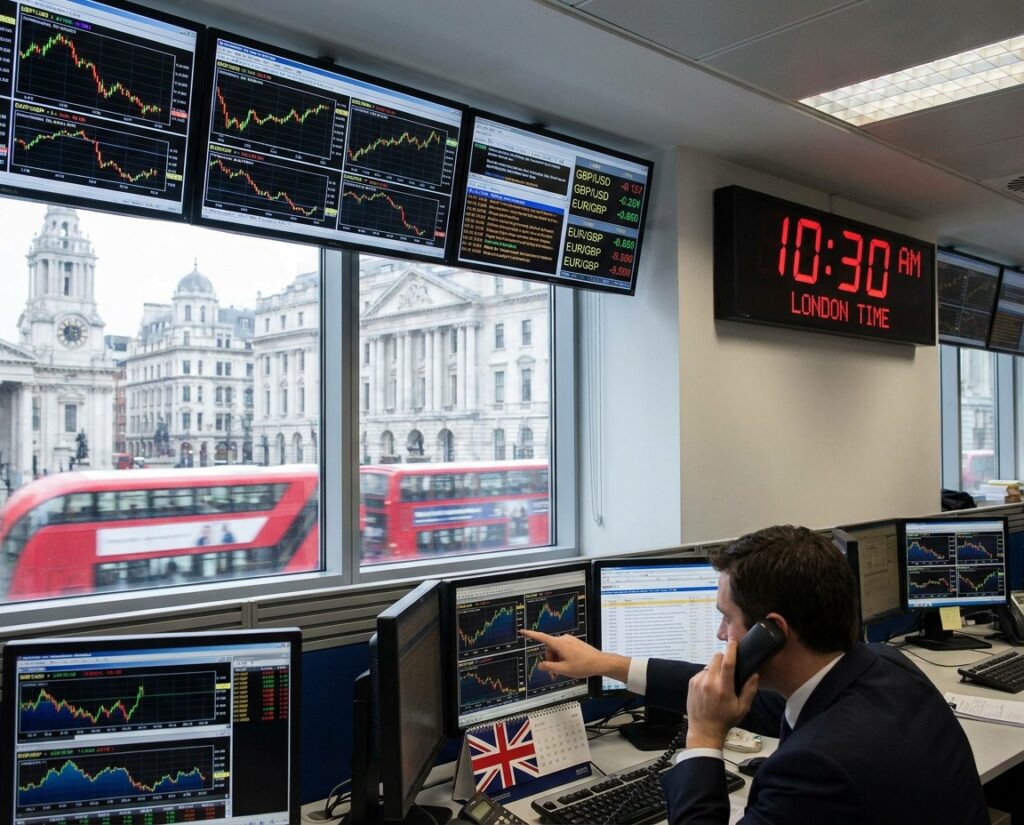
What Is Trading?
At its simplest, a trade exchanges one asset or financial claim for another. A stock trader exchanges cash for shares. A currency trader exchanges exposure to one currency against another. A futures or CFD trader enters a derivative whose value depends on movement in an underlying market rather than purchasing that market directly.
Modern retail trading platforms make the process appear almost frictionless. Markets can be searched, charts analysed and orders submitted from a phone within seconds. The underlying financial system is considerably larger. Banks, pension funds, asset managers, hedge funds, corporations, market makers and individual traders are all buying, selling and hedging for different reasons.
The foreign exchange market provides a useful illustration of that scale. The Bank for International Settlements measured average OTC foreign exchange turnover at roughly $9.6 trillion per day in April 2025. Much of that activity came from dealers and financial institutions rather than private speculation. The BIS Triennial Survey reported that interdealer activity represented 46% of turnover while other financial institutions accounted for roughly half.
A retail trader participates around the edges of markets built primarily around much larger institutional flows.
Trading vs Investing
Trading normally places greater emphasis on the timing of price movement. Investing places greater emphasis on what an asset may produce or become worth over longer periods. The same person can do both, and the same security can appear in both accounts.
Consider a trader buying a technology company at $100 because it has broken above a six-month resistance level. The position might have a target near $112 and an exit below $96. The entire idea could play out within two weeks. A long-term investor buying the same stock might care instead about revenue growth, profit margins, competitive position and whether the company could be substantially larger five years from now.
The difference becomes most important when a position goes wrong. A failed short-term trade should not automatically become an investment simply because selling would realise a loss. The original reason for holding it has changed. A position entered for a two-day momentum move cannot be justified after the fact using a ten-year valuation argument.
Investors can tolerate price fluctuations when the underlying thesis remains valid. Traders usually need a clearer point where the setup has stopped behaving as expected.
Time horizon therefore belongs inside the decision before the order is placed.
Markets Traders Can Use
Shares are one of the most familiar trading markets. A trader can buy individual companies, sell them where short selling is available, or use exchange-traded funds to gain broader exposure. Stocks respond to company earnings, industry developments, economic conditions and changes in investor expectations. Liquidity varies greatly, so trading a global blue-chip company is operationally very different from trading a thinly traded small-cap share.
Forex focuses on the relative value of currencies. EUR/USD, GBP/USD and USD/JPY are among the heavily traded pairs, while smaller currencies can have wider spreads and less consistent liquidity. Currency prices respond heavily to interest-rate expectations, inflation, economic data and central-bank policy. Forex is also commonly traded with leverage, which makes relatively small exchange-rate movements capable of producing large changes in account equity.
Futures provide standardised exchange-traded contracts on markets including equity indices, commodities, currencies and interest rates. Contract specifications and leverage make them attractive to active traders, but the value of each tick and the margin required need to be understood before a position is opened.
Options add another layer because price depends not only on the underlying market but also on factors including time remaining and expected volatility. They can be used for speculation, hedging or structuring defined-risk positions. Their flexibility is useful, though it creates considerably more moving parts than simply buying a share.
CFDs and Other Leveraged Derivatives
Contracts for difference provide another route to market exposure in jurisdictions where retail CFDs are permitted. A CFD trader does not purchase the underlying share, currency or index. Instead, the customer and provider exchange the financial difference between the opening and closing prices of the contract.
The main attraction is flexibility. CFDs commonly permit long and short positions across several asset classes from one account, while margin means the full notional position value does not need to be deposited at the beginning. That same feature is the principal risk. A £2,000 margin deposit can support substantially more than £2,000 of market exposure, so profit and loss are generated by the larger position rather than the small amount used to establish it.
Regulators have responded accordingly. In the UK, the FCA’s permanent retail CFD rules restrict leverage between 30:1 and 2:1 depending on the underlying asset, require account-level margin close-out at 50% of required margin and provide negative balance protection for eligible retail clients. The FCA CFD rules were introduced specifically because the regulator considered excessive leverage and poor retail outcomes a source of consumer harm.
Leverage changes how quickly a trading result reaches the account. It does not improve the quality of the prediction.
Day Trading
Day trading means opening and closing positions within the same trading session. Traders can use stocks, futures, forex, options, CFDs and other instruments, depending on their jurisdiction and account. The defining feature is normally the absence of an overnight position rather than one particular entry method.
A day trader might buy a breakout from the morning range, trade momentum after earnings or short a market after an intraday rally fails. Holding periods can last several hours or only a few minutes. Removing overnight exposure reduces the risk of waking up to a large gap caused by unexpected news, but shorter holding periods make execution and transaction costs more important.
Trading frequency creates another problem. A swing trader can spend a week managing one position, while a day trader might place ten trades before lunch. That creates ten opportunities to break a stop, chase an entry or increase risk after a loss.
Day trading is therefore not simply investing performed more quickly. It creates a different operating environment where decision quality has to remain consistent under repeated short-term feedback.
Scalping
Scalping compresses trading into very short periods, sometimes seconds or a few minutes. Rather than waiting for a large trend, the trader attempts to capture relatively small movements repeatedly. Highly liquid forex pairs, futures and actively traded shares are common markets because narrow spreads are particularly valuable when profit targets are small.
The economics are unforgiving. Suppose a scalping strategy produces an average gross edge of $8 per trade before costs. If the combined spread, commission and slippage average $6, only $2 remains. A small deterioration in execution can remove the edge completely even when the entry signals continue to behave exactly as expected.
This is why scalpers tend to care intensely about execution speed, spreads and order handling. It also explains why backtesting short-term strategies using ideal chart prices can be misleading. Historical midpoints do not reproduce the actual bid and ask prices at which live orders execute.
Scalping can produce a high number of observations quickly, but those observations are only useful when execution is measured realistically.
More trades do not automatically mean more opportunity. They also mean more friction.
Swing Trading
Swing trading holds positions for several days or weeks in an attempt to capture a larger section of a market move. The trader might buy a pullback inside an established trend, enter after a multiweek breakout or position around a fundamental catalyst expected to influence price beyond one trading session.
The slower timeframe reduces dependence on tiny execution differences. A five-cent disadvantage at entry matters much less when a trader is pursuing a $5 move than when targeting 20 cents. The trade-off is overnight exposure. Earnings announcements, economic data and unexpected political events can cause markets to open far from the previous closing price.
A stop loss therefore cannot guarantee the planned loss on a swing trade. If a stock closes at $50 with a stop at $47 and unexpected news causes the next available price to be $40, an ordinary stop cannot create liquidity at $47.
Swing traders need to account for that gap risk through position size, especially when holding individual companies through known events.
The method provides more time to think than intraday trading, but less control over what can happen between decisions.
Trend Trading
Trend trading attempts to participate in directional persistence. If an asset is already making progressively higher highs and higher lows, a trend trader can favour long positions on the assumption that the movement may continue. A falling market produces the opposite bias.
Trend strategies can operate over almost any timeframe. A day trader can follow an intraday trend, while a position trader may hold a trend for several months. This is why trend trading describes the logic of the position rather than how long it remains open.
The method does not require a high win rate. Markets repeatedly appear to begin trends and then reverse. A trader can therefore experience several small failed entries before one large movement produces a winner large enough to compensate. That pattern can be profitable while feeling psychologically unpleasant because the trader is wrong more often than expected.
Trading performance is not determined by how frequently a prediction is correct. It depends on the relationship between average gains, average losses, win rate and costs.
A strategy winning 40% of its trades can make money. A strategy winning 80% can still lose it.
Momentum Trading
Momentum traders look for markets where buying or selling pressure is already unusually strong. A stock rising sharply after better-than-expected earnings may attract institutional repositioning, short covering and additional speculative demand. The trader attempts to participate while that process continues.
The danger is confusing strength with an attractive entry. A market can be genuinely strong while already being too extended for the available reward to justify the risk. Buying after a nearly vertical move may leave the trader with a choice between placing a wide stop or accepting that ordinary volatility could trigger a narrow one.
Momentum strategies therefore need some way of defining when strength remains tradable. Some traders enter immediately after a breakout, while others wait for a short consolidation or pullback. The exit matters equally. Once the behaviour that justified the position disappears, the fact that the asset was strong an hour earlier has little value.
Momentum works because price can continue moving after the original catalyst. It fails when traders assume continuation is compulsory.
Markets are allowed to change their mind faster than the trader does.
Mean Reversion
Mean reversion starts from almost the opposite assumption. Instead of expecting a move to continue, the trader believes price has temporarily become unusually stretched and may return closer to a typical level.
The reference can be a moving average, VWAP, statistical band or previous trading range. A day trader might buy an index after a sharp move below its normal intraday range, while a swing trader could look for a rebound after several unusually weak sessions.
Mean-reversion systems often produce many small successful trades because markets frequently oscillate. The serious risk appears when a temporary-looking deviation is actually the start of a larger directional move. A share does not need to return to last week’s average after unexpected information changes what investors believe the business is worth.
Repeatedly adding to a losing mean-reversion trade can be particularly dangerous. The market becoming more stretched does not necessarily make the original thesis more correct.
An extreme reading can identify unusual conditions. It cannot compel price to reverse.
Breakout Trading
Breakout traders look for price moving beyond a level that previously contained it. A stock trading between $70 and $75 for several weeks might attract interest once price moves convincingly above $75. The trader interprets the breakout as evidence that the previous balance between buyers and sellers has changed.
The advantage is a relatively clear structure. The old resistance area provides a reference for determining whether the breakout remains valid. The weakness is false breakouts. Price can move beyond a widely watched level, attract new orders and then reverse back into the old range.
Some traders attempt to filter those failures by waiting for higher volume, a closing price outside the range or a later retest of the level. Each method trades better confirmation for a less favourable entry.
No filter removes false breakouts completely, which is why position size and exit rules remain more dependable than searching for one perfect signal.
Breakout trading is not about knowing with certainty that resistance will fail. It is about structuring a trade where failure can be identified before it becomes too expensive.
News and Event Trading
News traders focus on periods where new information forces investors to reprice an asset. Earnings releases, central-bank decisions, inflation data, employment reports, regulatory decisions and corporate takeovers can all produce rapid movement.
Markets react primarily to the difference between what happened and what participants expected. A company can report record profits and still see its share price fall if investors expected even better results. An interest-rate increase can coincide with a falling currency if the market had already priced a more aggressive central-bank decision.
Execution becomes harder during these periods. Spreads can widen and available liquidity can disappear as prices move quickly. A stop order may execute significantly away from its trigger because nobody was willing to transact at the intermediate prices.
Retail traders also compete with automated institutional systems capable of processing scheduled information extremely quickly. Trying to win the first milliseconds of a news release is therefore a difficult contest.
Trading the reaction after the first repricing can be more realistic. Important information can create trends lasting hours, days or longer even after the fastest participants have acted.
Technical Analysis
Technical analysis uses price, volume and related data to organise trading decisions. Common tools include support and resistance, moving averages, trend lines, volatility measures, volume and momentum indicators.
The useful part of technical analysis is not the visual complexity of the chart. It is the ability to turn an observation into a repeatable rule. “The stock looks strong” is difficult to test. “Buy when price closes above a 20-day range while volume exceeds its recent average, then exit below the breakout level” can be evaluated over many observations.
Indicators should also be recognised as transformations of existing information rather than independent sources of knowledge. RSI, moving averages and MACD are all derived largely from price. If all three turn bullish after the same rally, the trader may have three displays reflecting one underlying fact rather than three separate confirmations.
Technical tools work best when they perform different jobs. One can define trend, another can help locate an entry, while market structure determines where the idea becomes invalid.
The chart should simplify a decision. Adding indicators until the screen resembles aircraft instrumentation rarely improves the mathematics.
Fundamental Analysis
Fundamental traders examine the economic forces likely to affect the value of an asset. For shares, that can include earnings, revenue, margins, competitive position and balance-sheet strength. Currency traders may concentrate on interest rates, inflation and central-bank policy, while commodity traders can study supply, inventories and demand.
Fundamentals can matter even over short periods because new information can force large investors to adjust positions. An earnings surprise can produce several days of follow-through as analysts revise forecasts and institutions alter exposure. A shift in monetary policy expectations can drive a currency trend for weeks.
The main problem is timing. A fundamental argument can be correct while price moves in the opposite direction for far longer than the trader expected. Markets also price expectations in advance, so apparently positive information can cause a decline if investors had already expected something better.
Fundamental analysis therefore explains why an asset may deserve repricing. It does not always identify exactly when that repricing will occur.
Many traders combine fundamental context with technical timing for this reason.
Market and Limit Orders
Order type determines how a trading idea reaches the market. A market order prioritises execution. The trader accepts the best available price rather than requiring one exact level. This can be useful when entering or exiting promptly matters more than small price differences, but the final execution can differ from the last visible quote in fast markets.
A limit order prioritises price. A trader specifies the maximum price they will pay or the minimum price they will accept. The disadvantage is that the market may never trade at that level, leaving the position unfilled.
Stop orders are commonly used for risk control or breakout entry. Once the trigger is reached, an ordinary stop generally converts into another order type, commonly a market order. Execution can therefore occur away from the stop level when prices move quickly.
The right order type depends on what matters more for that trade: getting the position executed or controlling the price.
There is no order that guarantees both under every market condition. Trading always involves some compromise between certainty of execution and certainty of price.
Leverage and Margin
Leverage allows traders to control market exposure greater than their own deposited capital. It can make a small market movement financially meaningful, which is why leveraged products appeal to short-term traders. The arithmetic works exactly the same way when the position is wrong.
If $10,000 of capital supports $50,000 of market exposure, a 2% movement in the underlying represents approximately $1,000 before costs. That equals 10% of the original account even though the asset itself moved only 2%.
Margin should therefore not be confused with risk. Margin is the amount a broker requires to support the trade. Risk depends on the position size and how far price moves before the position is closed.
Investor.gov’s guidance on margin accounts warns that margin increases purchasing power while exposing investors to larger losses and potentially forced liquidation. Broker-dealers can also impose margin requirements stricter than regulatory minimums.
Maximum buying power is an account limit. It is not a suggested position size.
Position Sizing
Position sizing determines how much damage one incorrect trade can do. A sensible process starts by deciding where the trading idea becomes invalid and how much money the account can reasonably lose if that happens.
Suppose a trader is prepared to risk $200. A stock is entered at $50 with a logical stop at $49, producing $1 of planned risk per share. Approximately 200 shares correspond to the intended $200 loss before commissions and slippage. If another stock requires a $4 stop because it is much more volatile, only around 50 shares fit the same risk allowance.
This makes position size responsive to market conditions. Buying 1,000 shares of every company simply because 1,000 is a familiar number can produce radically different risk depending on how much each stock normally moves.
The same principle applies to futures contracts, currency units and leveraged CFDs. Contract calculations differ, but the question is unchanged: how much money leaves the account if the trade does not work?
Position sizing is one of the few important decisions a trader can make before uncertainty begins doing its part.
Risk to Reward and Expectancy
A reward-to-risk ratio compares the intended profit with the amount planned to be lost if the trade fails. Risking $100 to target $300 produces a theoretical three-to-one ratio. The number is useful, but only when combined with the probability of each outcome.
A trader can invent an impressive reward-to-risk ratio simply by placing the target very far away. If that target is almost never reached, the calculation has little practical value. Expectancy deals with this by considering average winner, average loser and the frequency of each.
A strategy winning 40% of its trades can be profitable when successful positions are substantially larger than failures. Another winning 75% can lose if the occasional loss becomes several times larger than the typical gain.
Trading should therefore not be judged primarily by win rate. People naturally like being correct, but the account cares about money rather than accuracy.
The relevant result appears after the entire distribution of wins, losses and trading costs has been combined.
Trading Costs
Every trading method has friction. Depending on the instrument, that can include commissions, bid and ask spreads, exchange charges, financing, borrowing costs and slippage. The importance of each cost depends heavily on holding period and frequency.
A long-term investor making six transactions per year may barely notice a small commission. A scalper making several hundred trades can have the same fee become a major part of total performance. Overnight financing reverses the comparison: it may be irrelevant to a day trader and substantial to a leveraged swing position held for a month.
Margin borrowing introduces another direct expense. Investor.gov notes that margin loans carry interest and that this financing cost raises the return the investment needs to generate merely to break even. Investor.gov’s margin interest guidance explains why borrowing costs should be included in performance rather than treated as an administrative detail.
Gross returns can make a strategy look impressive. Net returns decide whether it actually worked.
Choosing a Broker
Broker selection begins with the legal company rather than the trading app. International firms can operate several subsidiaries under one brand, each subject to different regulation, leverage rules and customer protections. The account agreement should identify the exact entity taking responsibility for the relationship.
Regulator databases provide the next check. In the UK, the FCA Firm Checker shows whether a company is authorised and has permission to provide the relevant services. The FCA states that using a firm with the correct authorisation improves the likelihood that applicable consumer protections will be available, although it does not remove market risk.
Once the legal entity has been verified, practical factors can be compared. Frequent traders care heavily about spreads, commissions and execution. Swing traders may care more about overnight financing and market access. Short sellers need stock availability, while algorithmic traders need suitable APIs or automation.
A broker cannot make an unprofitable strategy profitable merely through attractive branding. A poor broker can, however, remove a small edge through bad pricing, weak execution or excessive costs.
Offshore Brokers and Regulatory Risk
An offshore broker can offer higher leverage, different products or lower margin requirements than a trader’s domestic regulated market. That can provide genuine capital efficiency for experienced traders who maintain the same position size while keeping less cash at one counterparty.
The danger appears when additional buying power becomes additional exposure or when customer protections are materially weaker. Client money rules, negative balance protection and dispute procedures vary between jurisdictions. An international brokerage group can also operate a strongly regulated domestic company and a separately incorporated offshore company under the same brand.
This is why regulation must be checked at entity level. A licence held by one subsidiary does not automatically cover another.
The FCA’s current guidance on checking authorised firms specifically warns consumers about unauthorised and clone firms and advises matching the company’s details against the official register.
Trading creates enough market risk on its own. Adding uncertainty about whether a broker will return the account balance is rarely an attractive source of extra excitement.
Trading Psychology
Trading psychology matters because financial decisions produce immediate emotional feedback. A losing position creates discomfort, which can encourage the trader to move the stop farther away rather than accept the planned loss. A profitable position creates another temptation: closing too early because the certainty of a small gain feels better than allowing the strategy to continue.
Several losses in succession can produce revenge trading, where the next position is chosen partly because the trader wants to recover previous money. Several winners can produce the opposite problem. Confidence rises, position size increases and one oversized loss removes the gains produced by earlier discipline.
Boredom deserves equal attention. Traders who spend hours watching markets can begin taking marginal setups because inactivity feels unproductive. The market does not pay people for screen time.
The purpose of a trading plan is not to remove emotion. Traders remain human whether or not a spreadsheet says otherwise. The goal is to decide enough in advance that emotion cannot easily change position size, invalidation points or entry standards while capital is already at risk.
Good trading behaviour is often less dramatic than poor trading behaviour. That may be one reason it photographs badly.
Backtesting and Strategy Development
A trading idea becomes more useful once it is precise enough to test. “Buy strong markets” is too vague because strength can mean something different after every chart has already moved. A testable strategy defines the condition, entry, exit and risk rules clearly enough that another person could identify broadly the same historical trades.
Backtesting can then estimate how the rules behaved under previous market conditions. Realistic costs are important. A strategy tested using perfect entries at chart midpoint prices can look considerably better than one required to cross actual spreads and experience slippage.
Historical testing also creates the danger of overfitting. Rules can be adjusted repeatedly until they describe past data extremely well while having little ability to survive future conditions. Testing on data not used during strategy design helps reduce that problem.
Simulation provides another stage, followed by small live trades where execution and trader behaviour become real. None of these stages proves future profitability. They provide increasingly demanding evidence before larger capital is exposed.
Markets change. The point of testing is not certainty. It is to stop complete guesswork pretending to be a strategy.
Trading Journals
A trading journal records what happened closely enough that the trader can later separate memory from evidence. This matters because people remember unusually large wins and painful losses while forgetting much of the routine activity between them.
The journal can record the setup, entry, intended risk, actual exit and whether the rules were followed. Over time, this allows performance to be divided by strategy, market condition or time of day. A trader may discover that morning breakouts work well while late-session trades lose money, or that a supposedly profitable news strategy gives most of its theoretical edge back through slippage.
The journal should also separate a good process from a good result. A correctly executed position can lose because trading involves probability. A badly oversized position can make money through luck.
Rewarding the second trade simply because it produced a profit teaches the wrong lesson. Eventually the same behaviour can appear during a trade where luck does not arrive.
Review is therefore less about admiring winners than identifying which decisions deserve to be repeated.
Current Rules Can Matter to Active Traders
Trading rules depend on market and jurisdiction, and they can change. US equity day traders provide a recent example. FINRA’s new intraday margin requirements became effective on June 4, 2026 and replace the old Pattern Day Trader framework once a brokerage firm transitions. The new approach removes the automatic $25,000 minimum and trade-count-based PDT designation, instead focusing on intraday margin relative to the positions actually held.
The transition remains important because firms have until October 20, 2027 to implement the new requirements. During that period one broker may still apply the older framework while another has already migrated. Traders therefore need to check their own firm’s rules rather than relying on an article written for another broker or another year.
Comparable differences exist internationally. Retail CFD leverage permitted in one jurisdiction can be unavailable in another, while taxation can change according to the legal instrument being traded.
Trading strategy therefore operates inside a legal and operational structure. Ignoring that structure does not make it disappear.
What Trading Really Requires
Trading offers something long-term investing does not: the ability to act on short and medium-term changes in price across many markets and in either direction where the chosen instrument permits it. That flexibility is genuine, and modern technology has made access easier than at almost any previous point.
Ease of access should not be confused with ease of profitability. Every active trader has to overcome transaction costs, uncertainty and their own inconsistent behaviour before the account produces a durable return. Leverage can make small edges more valuable, but it can also make ordinary mistakes disproportionately expensive.
The practical foundation is therefore fairly unglamorous. Define why a trade should exist, identify where that argument fails, calculate a position small enough to survive being wrong and measure what happens over enough observations to separate skill from short-term luck.
Markets will remain uncertain whatever indicator, strategy or platform is used. Trading does not require eliminating that uncertainty. It requires surviving it often enough for a genuine advantage, if one exists, to matter.