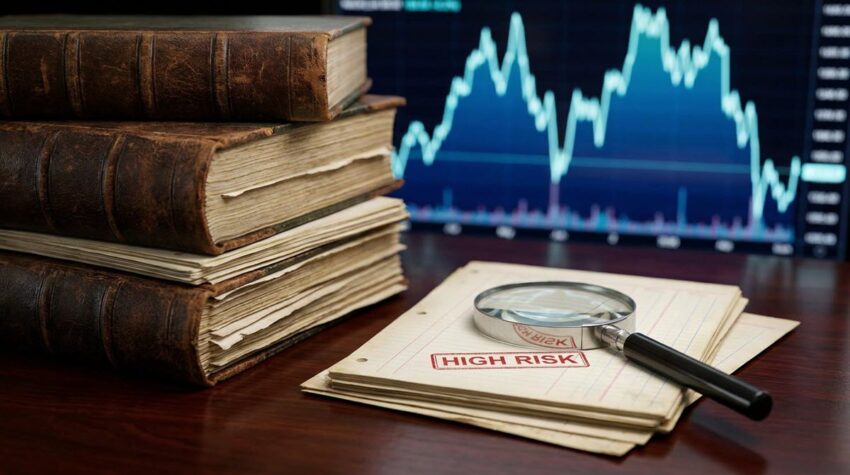
High risk financial instruments are investments or contracts that can produce large profits, but they can also cause large losses. They are usually more volatile than ordinary savings products and often depend on market prices moving in a certain direction.
Some investors use them to increase returns. Others use them to protect existing investments from price changes. The problem is that the same instrument can be useful in one situation and extremely dangerous in another.
Risk is not automatically bad. Investing always involves some risk. The real issue is whether the investor understands how much money could be lost, how quickly that loss could happen and whether borrowed money is involved.
What Makes a Financial Instrument High Risk?
A financial instrument becomes high risk when its value can change sharply or when losses can become larger than the original amount invested.
Several factors can increase risk.
Price volatility is one of the most obvious. Some assets can rise or fall by large percentages in a short period. If an investor buys at the wrong time, the loss may happen very quickly.
Leverage is another major factor. Leverage allows an investor to control a larger position with a smaller amount of money. This can increase profits, but it can also multiply losses.
Liquidity matters as well. Some investments are difficult to sell quickly. An investor may know an asset is falling in value but still struggle to find a buyer at a reasonable price.
Complexity also creates risk. If an investor does not fully understand how an instrument works, they may underestimate its possible losses.
Derivatives Can Produce Large Gains and Losses
Derivatives are contracts whose value depends on another asset.
That asset could be a share, currency, commodity, bond, interest rate or market index.
Options and futures are two common examples.
An option gives the holder the right, but usually not the obligation, to buy or sell an asset at an agreed price. Options can be useful because they allow investors to profit from expected market movements or protect an existing investment.
They can also expire worthless.
An investor who buys an option may lose the full amount paid for it if the market does not move as expected before the expiry date.
Selling certain types of options can be even riskier. In some cases, losses may become very large because the seller has agreed to take on an obligation if the market moves against them.
Futures contracts also involve risk because they require the buyer and seller to trade an asset at a future date for an agreed price.
Small price changes can create large gains or losses, especially when leverage is involved.
Contracts for Difference Carry Heavy Risk
Contracts for difference, usually called CFDs, allow traders to speculate on price changes without owning the underlying asset.
A trader may use a CFD to bet that a share price, commodity, currency or index will rise or fall.
CFDs often involve leverage.
This makes them attractive to traders who want exposure to a large position without paying the full value of that position.
That same feature makes them dangerous.
A small market movement against the trader can quickly reduce the money in the account. If the position continues moving in the wrong direction, the trader may be forced to add more money or close the position at a loss.
CFDs are not designed for people who assume that small deposits mean small risks.
The deposit may be small. The exposure is not.
Foreign Exchange Trading Can Be Highly Volatile
Foreign exchange trading involves buying one currency while selling another.
Currency markets are among the largest financial markets, but that does not make them safe.
Exchange rates can move because of interest rate decisions, inflation, political events, economic data and changes in investor confidence.
Retail forex trading often uses high levels of leverage.
A trader may control a position worth many times the amount of money placed in the account.
If the trade moves in the right direction, returns can appear impressive. If it moves in the wrong direction, losses can appear just as quickly.
Currency prices may also move sharply during unexpected news events.
That can make it difficult to close a position at the price the trader expected.
Cryptocurrencies Can Change Price Very Quickly
Cryptocurrencies are another high risk financial asset.
Some cryptocurrencies have experienced enormous increases in value, which has attracted investors looking for rapid returns.
They have also experienced very large price falls.
Cryptocurrency prices may be affected by regulation, market sentiment, technology problems, exchange failures and speculation.
Unlike traditional bank deposits, cryptocurrency holdings may not have the same forms of consumer protection.
An investor may also face operational risks, such as losing access to a wallet or using an unreliable trading platform.
The market can move twenty four hours a day, which means large price changes may happen when an investor is not actively watching the position.
High potential returns do not make the risk disappear. They are usually part of the same package.
Penny Stocks Are Often Unstable
Penny stocks are shares of small companies that trade at very low prices.
They can appear attractive because an investor can buy a large number of shares with a small amount of money.
The low price does not mean the investment is cheap.
Small companies may have weak financial positions, little trading activity and poor access to funding. Their share prices may move sharply after small amounts of buying or selling.
Information may also be harder to verify.
This makes some penny stocks vulnerable to manipulation.
A common example is a pump and dump scheme, where promoters encourage people to buy a low priced stock, pushing the price higher. The promoters then sell their own shares, leaving later buyers with heavy losses when the price falls.
A stock trading for a few cents can still lose nearly all of its value.
Junk Bonds Offer Higher Interest for a Reason
Bonds are often treated as safer investments than shares, but not all bonds have the same risk.
High yield bonds, sometimes called junk bonds, are issued by companies or organisations with lower credit ratings.
They usually offer higher interest payments because investors are taking more risk.
The main danger is default.
If the issuer cannot repay its debt, investors may lose some or all of their money.
The higher interest rate is not free money. It is compensation for accepting a greater chance of financial trouble.
During periods of economic weakness, high yield bonds can fall sharply because investors become more concerned about companies failing to meet their debt payments.
Leverage Can Turn Small Mistakes Into Large Losses
Leverage deserves special attention because it appears in many high risk instruments.
Suppose an investor has $1,000 and uses leverage to control a $10,000 position.
If that position rises by 5 percent, the gain is $500. Compared with the original $1,000, that looks like a 50 percent return.
The same mathematics works in reverse.
If the position falls by 5 percent, the loss is also $500.
A relatively small market movement has wiped out half of the investor’s starting capital.
This is why leveraged products can become dangerous so quickly.
The market does not need to collapse. It only needs to move far enough in the wrong direction.
High Risk Instruments Are Not Always Bad
High risk instruments are not automatically unsuitable.
Professional investors use derivatives, options and other complex products for legitimate reasons.
An airline may use futures to manage fuel price risk. An international company may use currency contracts to reduce the effect of exchange rate changes. A portfolio manager may buy options to protect a share portfolio from a market fall.
The instrument itself is not always the problem.
The way it is used matters.
A financial contract used to reduce an existing risk is very different from the same contract being used to make a highly leveraged bet.
Investors Need to Understand the Possible Loss
The biggest mistake with high risk financial instruments is focusing only on the possible return.
Marketing often highlights profits because profits are attractive.
Risk receives less attention.
A sensible investor should ask how much could be lost before asking how much could be made.
They should also understand whether the position can lose more than the original investment, whether leverage is involved, how easily the asset can be sold and what could cause the price to move sharply.
High risk investments can play a role in some portfolios, but they require knowledge, discipline and realistic expectations.
Large potential returns usually come with large potential losses.
That basic relationship is easy to say and surprisingly easy to forget.